Google
Showing posts with label Mobile Communication. Show all posts

Saturday, November 30, 2013

Frequency Reuse with Cellular Topology

Start this tutorial from : Introduction

Primitively mobile networks  (that should probably be called the 0g mobile network such as IMTS),were designed like TV networks... one very powerful base station catered to a large area. 

The IMTS by AT&T for instance in New York, had 12 channels only. This means that at a given time only 12 calls could be active. Because of limited channels, AT&T had to limit subscribers to 2000. On an average users had to wait around 20 minutes before there calls could be placed.

This user capacity limitation was overcome by using a Cellular Topology

A land area to be covered is divided into regular shaped cells(as big as 10-15 miles), which can be hexagonal, square, circular or some other regular shapes.Hexagonal cells are conventional because hexagons best resemble a circle. (as a BTS would radiate around itself in more or less a circular radius)
Cluster of Cells
A cluster of cells
Each cell is served by one or more fixed-location transceiver, known as a cell site or base station. A mobile device would communicate with a cell-site most closest to it. Every radio base stations transmits/receives information in its cell at a particular frequency range from f1 - f6 . The group of frequencies can be reused in other cells, provided that the same frequencies are not reused in adjacent neighboring cells as that would cause co-channel interference.


How capacity is improved by cellular topology?


In IMTS : 
we can think the entire area A as one big cell with one BTS. 
Let total number of channels = 14Number of Active calls that can be supported in area A = 14
In Cellular: 
Let A be divided in 10 clusters
No. Of cells in one cluster = 7 Number of channels per cluster = 14/7 = 2
Number of channels in area A = (14*10)/7=20Number of Active calls that can be supported in area A = 20
This was a short description of channel multiplication using frequency reuse. Now, that we know basic concepts behind cellular topology, we shall for now, stop here. There's a lot more to frequency re-use and cell planning which is a major field research and application. Cell planning is a science in itself.


Do you have Questions? Arguments? doubts?... we'll try our best to resolve

Provide us with valuable Suggestions / Ideas / or clues... 
Please leave us a comment

Monday, November 4, 2013

Mobile Communication Systems - Basics

Now, let us see what makes up a communication system. A very basic components are

  1. SOURCE the beginning point 
  2. INFORMATION or DATA to be conveyed
  3. CARRIER or MEDIUM that will take data from source to destination
  4. RECIPIENT

Now, the very important requirement for communication, is a MEDIUM through which information will flow from the SOURCE to the RECIPIENT. For wireless systems this medium is called the CARRIER, which consists of waves of given frequency. For mobile telephony, RADIO FREQUENCY range is used.

The carrier can be modulated in a variety of ways to embed data/information into it. It is then signaled from a transmitter. The receiving end has a receiver that captures this signals and demodulates it to decipher the embedded data/info/message.

Since there are so many different mobile carriers, to avoid exchange of signals and interference, each carrier can use only an allotted  frequency range from the spectrum. That is why the radio spectrum has become a very valuable asset.

MOBILE NETWORKS

mobile network is a radio network distributed over huge land areas. Terminal devices or mobile phones can move around in this land areas and still communicate.

In order to support communication between subscribers we need a pair of RF channels per active call. 1 Channel requires atleast two frequencies, one for forward link and one for reverse link.

In large cities where operators could have thousands of subscribers, we would require a large number of channels. A given base station can transceive only at a given frequency range, and the number of channels would be limited. Also there is a limit to availability of spectrum. 


forward and reverse path communication

If an operators get a 1 MHz band, and has 12 channels to use and  only one base station to cover the entire state, then at any given time it could support only 12 active calls at max. To overcome this limitation, you have to create zones of coverage, which are called as cells. 


Do you have Questions? Arguments? doubts?... we'll try our best to resolve

Provide us with valuable Suggestions / Ideas / or clues... 
Please leave us a comment

Thursday, October 24, 2013

More or Less... We're Wireless

You may be wondering why I am posting about Wireless mobile communication systems.
They have been there since decades! What's new about them ?

Well you are right, there's nothing new about them. They have evolved for so many years. 
But the interesting thing is they don't stop evolving..  from simply "cellular technology" to 3G, 4G and 5G or the LTE advanced... wireless technology is always renewing.

This and some more following posts will help you quickly learn how wireless technology evolved and soon you will be up-to-date with recent advances.

What Qualifies to be called a Wireless Communication System?

Communication - means transfer of data from one point to another. 
Any transfer of information between two or more points that are not physically connected by wires is wireless communication. 

Therefore, even when you talk to your friend sitting beside you, technically you are communicating "wireless-ly". But since we are Engineers, let's leave aside these naive examples.

We will consider only technologically advanced wireless data transfer as wireless communication. So, more complex examples of wireless communication systems would be:

Short Distance : TV controlled by remote
OR
Long Distance : Space Radio Communication

A Piece of Fun Fact

(click on image for magnified view)


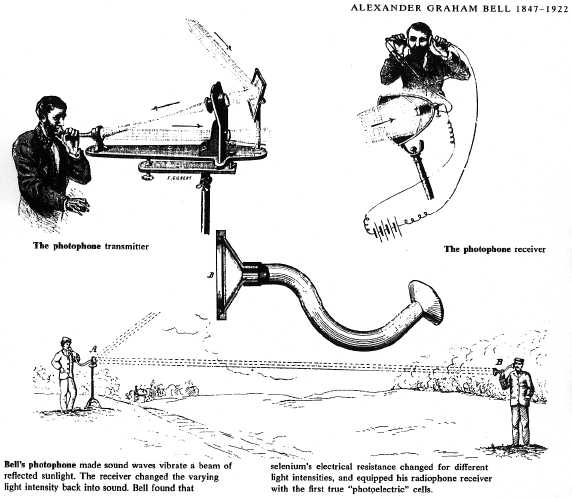
The world's first wireless telephone conversation occurred in 1880, when Alexander Graham Bell and Charles Sumner Tainter invented and patented photophone, a telephone that conducted audio conversations wirelessly over modulated light beams


photophone


At that time this invention was practically useless. Decades later the photophone's principles found their first practical applications in military communications and later in fiber-optic communications.
This happened in that primitive era when electricity was a luxury, and lasers had not even been conceived of in science fictions. The transmitter required a clear line-of-sight with the receiver. (As light rays were carrying the info). Another requirement was sun-light and good weather to operate.

Evolution milestones of Mobile Communication Technology

The following map summarizes the evolution of cellular technology generations.
(click on image for magnified view)
Summary of Cellular Technology Generations


Although there are so many different wireless technologies from WLAN and Bluetooth to radio space communications, for this series we will be limiting ourselves to Wireless Mobile communications, as that is the most widely used wireless technology these days.


Do you have Questions? Arguments? doubts?... we'll try our best to resolve
Please leave us a comment